Choosing between single and multi-page website architectures has always been a critical decision for businesses. Now with the rise of AI-driven search experiences, this choice takes on new dimensions through the lens of Answer Engine Optimization (AEO). The structure you select doesn't just impact user experience—it fundamentally shapes how AI systems discover, interpret, and feature your content as direct answers.
As businesses adapt to the evolving search landscape, understanding how website architecture influences AEO performance has become essential for maintaining visibility. This comprehensive guide examines both single and multi-page approaches, providing clarity on which structure best serves your specific business needs in an AI-first search environment. Research indicates that strategic website architecture decisions can dramatically impact how frequently your content appears in AI-generated responses.
The single versus multi-page website debate has gained new urgency with the emergence of answer engines like Google's SGE, Perplexity, and ChatGPT. Website architecture is no longer just about user navigation preferences—it directly influences how AI systems parse, understand, and ultimately present your content as authoritative answers. The decision you make affects not only traditional search visibility but also your presence in the growing ecosystem of AI-generated responses.
What makes this decision particularly challenging is that different business types benefit from different structures when it comes to AEO. A local service business with limited offerings might excel with a hyper-focused single-page site, while a content publisher or e-commerce store typically needs the robust framework of a multi-page architecture to achieve optimal AI visibility. Finding your ideal structure requires balancing immediate AEO performance with long-term content scalability.
"Website structure isn't just about organization—it's about creating an architecture that both human users and AI systems can easily navigate to find precise answers to their questions. The right structure signals to AI systems exactly what expertise you offer and how your content should be positioned in answer-driven search results." — AEO Research from Next Level Local Online
Answer Engine Optimization represents a fundamental shift in how we approach visibility in search. While traditional SEO focuses on ranking pages in a list of search results, AEO targets position zero—having your content directly featured as the answer within AI-generated responses. This distinction is crucial because it changes what we optimize for and how we structure information online.
Your website's architecture plays a pivotal role in communicating authority and relevance to AI systems. Whether you choose a single or multi-page approach, the underlying goal remains consistent: present information in a way that AI can confidently extract and attribute to your brand. The difference lies in how each structure accomplishes this goal and which business contexts they serve most effectively.
The website structure you select creates the foundation for all your AEO efforts. It determines how easily AI systems can identify topic relationships, assess content depth, and extract direct answers from your content. Both single and multi-page approaches can work for AEO, but their effectiveness varies dramatically based on your specific business needs, content strategy, and growth trajectory.
Answer Engine Optimization is the strategic practice of structuring and presenting content specifically to be featured in AI-generated direct answers. Unlike traditional SEO which primarily focuses on ranking individual pages, AEO targets having your content extracted, synthesized, and presented as the authoritative response to specific queries. This emerging discipline requires clear semantic structure, direct question-answer formats, and content organized around specific user intents.
At its core, AEO acknowledges that search is evolving from a link-based discovery tool to an answer-delivery system. When users interact with AI search interfaces, they often receive direct answers rather than being directed to specific web pages. Successful AEO ensures your business becomes the source of those answers, maintaining visibility and authority even as traditional search results become less prominent in the user experience.
Traditional SEO primarily focuses on ranking individual URLs for specific keywords, with success measured by position in search results pages. AEO, however, targets content extraction and attribution in AI-generated responses, where users may never see your actual website. This fundamental shift requires different optimization approaches and structural considerations.
While SEO often emphasizes factors like keyword density and backlink profiles, AEO prioritizes clear semantic structure, direct answers to specific questions, and comprehensive topical coverage. Your content needs to not only rank well but be structured in a way that makes it easy for AI to extract precise answers. This means using proper heading hierarchies, structured data markup, and content organized around question-answer pairs.
The metrics for success differ as well. Where SEO targets traffic and rankings, AEO measures attribution in AI responses, featured snippet capture rate, and visibility in zero-click search environments. This shift doesn't make traditional SEO irrelevant—rather, it builds upon that foundation with additional structural and formatting requirements specific to AI systems.
AI systems rely heavily on content structure to understand relationships between topics and identify authoritative answers. Your website architecture directly influences how these systems crawl, index, and connect information across your domain. A well-structured website makes it significantly easier for AI to determine your areas of expertise and extract relevant answers from your content. For a deeper dive into this, explore the truths vs. myths surrounding AI discoverability.
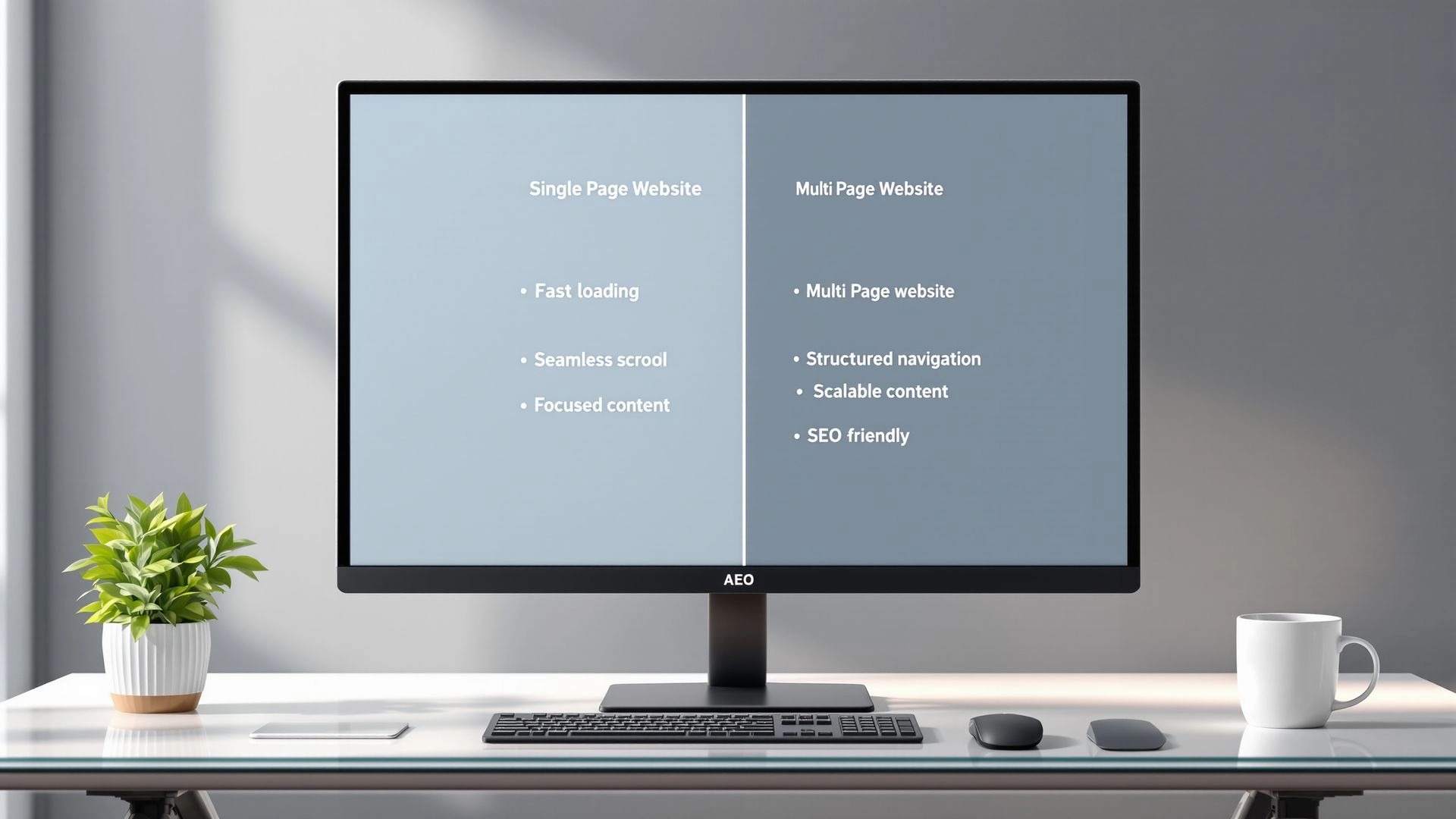
The way you organize information—whether across multiple pages or within a single page—affects how AI systems assess your topical authority. Multi-page structures allow for clear topic hierarchies and in-depth exploration of individual subjects, while single-page sites must efficiently organize information to maintain clear semantic relationships despite limited space. Both approaches can work for AEO, but they serve different content strategies and business needs.
Single-page websites consolidate all content onto one continuous page, typically using anchor links for navigation between sections. This architecture has gained popularity for its simplified user experience and mobile-friendly design. From an AEO perspective, single-page sites present both unique advantages and significant challenges that businesses need to carefully consider before implementation.
The concentrated nature of single-page websites creates an interesting dynamic for AI systems analyzing content. With all information presented on one URL, these sites can efficiently communicate core offerings and direct answers for specific queries. However, this same concentration often limits the depth and breadth of content that can be reasonably included without overwhelming users.
Single-page websites typically employ JavaScript frameworks like React or Vue.js to create smooth, app-like experiences where content dynamically loads as users scroll or navigate via anchor links. The technical foundation includes a unified HTML document with distinct sections delineated through semantic markup, making the content appear as separate "pages" to users while remaining within a single URL.
Navigation in these structures relies heavily on anchor links (#section-name) that scroll users to specific content areas rather than loading new pages. This approach eliminates page-load delays but creates challenges for analytics tracking and can complicate how AI systems identify and extract specific content sections. From an AEO perspective, proper semantic structure becomes even more critical to help AI systems understand content boundaries and relationships.
Modern single-page sites often implement progressive loading techniques to maintain performance despite having all content on one URL. This approach helps maintain speed by loading only the initially visible content, then gradually adding more as users scroll. While beneficial for user experience, this can create indexing challenges if AI systems cannot properly access and process dynamically loaded content.
Single-page websites excel at providing concise, focused answers to specific queries about clearly defined offerings. This concentrated approach can be particularly effective for businesses with limited service offerings where all relevant information can be comprehensively covered in one coherent narrative. AI systems can easily extract direct answers when content is tightly focused around a specific expertise area.
User engagement metrics often shine on well-executed single-page sites, with visitors spending more time on page and experiencing fewer navigation interruptions. These positive signals can indirectly benefit AEO performance, as AI systems increasingly incorporate user experience factors when determining content quality and relevance. The seamless scrolling experience also encourages users to consume more content in a single session, potentially increasing topical comprehension signals.
Technical performance advantages include faster initial page loads (when properly optimized) and simplified maintenance with only one page to update. These efficiency factors can contribute positively to overall user experience signals that influence AI systems' content quality assessments. Additionally, the consolidated URL structure makes internal linking strategies straightforward and eliminates potential canonicalization issues that multi-page sites often face.
Multi-page websites distribute content across numerous distinct URLs, each focused on specific topics, services, or user intents. This traditional architecture remains the backbone of most content-rich websites, from e-commerce platforms to informational sites. The distributed nature of multi-page structures creates both significant advantages and potential challenges for AEO implementation.
The separation of content into distinct pages allows for precise topic focusing and intent matching—qualities that AI systems rely on when extracting answers. Each page can be optimized for specific query clusters, creating clear topical boundaries that help AI systems understand your areas of expertise. However, maintaining consistency and proper interlinking across many pages requires more substantial content governance.
Multi-page websites organize content into a hierarchical structure with distinct URLs for each page, creating clear topic boundaries and navigation paths. This architecture relies on a logical site structure where related content is grouped into sections, categories, or folders that signal topical relationships to both users and AI systems. The hierarchical organization helps establish topical authority through clearly defined content clusters.
Navigation in multi-page sites typically employs traditional menus, breadcrumbs, and internal linking structures that guide users through logical content journeys. This explicit navigation framework also benefits AI systems by providing clear signals about content relationships and relative importance. From an AEO perspective, these structural signals help AI systems understand your content's context and position within broader topic ecosystems.
Each page on a multi-page site functions as a standalone entry point optimized for specific user intents and query clusters. This focused approach allows for precise targeting of various search intents without diluting relevance signals. For AEO purposes, this specialization enables each page to provide authoritative answers to specific question types, increasing the likelihood of being featured in AI-generated responses.
Multi-page websites excel at establishing topical authority through comprehensive content coverage across multiple related pages. This depth signals expertise to AI systems, which increasingly favor authoritative sources when generating answers. By creating dedicated pages for specific subtopics, multi-page sites can develop the content depth necessary to become trusted sources for AI-generated responses. This architectural advantage becomes particularly significant for businesses targeting complex query ecosystems where nuanced answers are required.
Despite their AEO advantages, multi-page websites face challenges in maintaining consistent content quality and structural coherence across numerous pages. Inconsistent formatting, contradictory information, or poor internal linking can confuse AI systems attempting to extract definitive answers from your content. These issues often multiply as sites grow larger, creating potential weak points in your AEO strategy that require proactive management.
Page load performance can become problematic for multi-page sites with heavy assets or poor optimization, negatively impacting user experience signals that influence AI evaluation. Additionally, complex navigation structures may create accessibility barriers that reduce content discoverability for both users and AI systems. Addressing these technical limitations requires ongoing performance monitoring and optimization to ensure your multi-page structure remains AEO-friendly.
When comparing single and multi-page structures for AEO performance, we need to evaluate how each architecture influences AI systems' ability to extract, attribute, and present your content as authoritative answers. This analysis goes beyond traditional SEO metrics to examine how structural choices impact content extraction, topic recognition, and answer synthesis in AI-driven search experiences. Understanding these differences helps businesses make architecture decisions aligned with their specific AEO goals.
Multi-page websites consistently outperform single-page sites in establishing topical authority through content depth. AI systems evaluate expertise partially based on comprehensive coverage of a topic across multiple pages, with each page adding to the overall authority assessment. Single-page sites necessarily limit content depth to maintain usability, creating a ceiling on how authoritative they can appear to AI systems for complex topics requiring nuanced exploration.
Multi-page structures excel at targeting diverse query clusters by creating dedicated pages for specific user intents. This precision allows AI systems to easily identify the most relevant content sections for specific questions, increasing the likelihood of your content being featured in AI-generated responses. Single-page sites must balance competing intents within one document, often resulting in less precise intent matching for secondary topics that might otherwise generate visibility in AI search results.
Single-page websites often generate stronger engagement metrics for focused topics, with users spending more time on the page and experiencing fewer navigation interruptions. These positive user signals can influence how AI systems evaluate content quality, particularly for straightforward queries where concise answers suffice. However, multi-page sites typically perform better for complex research journeys where users benefit from clearly structured content progression across multiple dedicated pages.
Single-page sites can deliver faster initial loading experiences when properly optimized, but often struggle with memory management as content volume increases. In contrast, multi-page structures distribute loading requirements across separate page requests, potentially creating more consistent performance across the user journey. From an AEO perspective, both architectures can meet performance requirements when properly implemented, making this factor less decisive than content strategy considerations for most businesses.
The technical implementation quality ultimately matters more than the architectural choice itself. Well-optimized websites of either structure that prioritize core web vitals, semantic markup, and accessibility will outperform poorly implemented alternatives regardless of the page model chosen. For AEO purposes, prioritize technical excellence within whichever architecture best supports your content strategy and business objectives.
The single versus multi-page decision should ultimately be driven by your specific business context, content needs, and growth trajectory rather than general preferences. Different business models benefit from different architectural approaches when optimizing for AI visibility. The key is matching your website structure to your specific content requirements and user journey complexity while considering how AI systems will interact with your chosen architecture.
Both structures can succeed with proper implementation, but they serve fundamentally different use cases and content strategies. Misalignment between your business needs and architectural choice can create significant limitations for your AEO performance that even perfect execution cannot overcome. Carefully evaluate your specific requirements against the inherent strengths and limitations of each approach before making this foundational decision.
Single-page websites perform best for focused businesses with limited service offerings that can be comprehensively covered without overwhelming content volume. Local service businesses like photographers, individual consultants, or specialized boutiques with clearly defined offerings often benefit from this concentrated approach. The focused nature of single-page sites works particularly well when your business targets a narrow set of closely related queries where content can be tightly organized around a specific expertise area.
Multi-page structures become essential for businesses with diverse offerings, content-driven strategies, or complex product ecosystems requiring detailed explanation. E-commerce stores, informational resources, educational platforms, and businesses serving multiple distinct audience segments all benefit from the scalability and topical specificity multi-page architectures provide. If your AEO strategy involves becoming the authoritative source across a broad topic ecosystem, the content depth and intent targeting capabilities of multi-page structures become virtually mandatory for success.
Innovative businesses are increasingly implementing hybrid approaches that combine single-page sections for high-conversion content with multi-page structures for detailed information and resource hubs. This balanced architecture leverages the streamlined user experience of single-page designs for core conversion paths while maintaining the content depth advantages of multi-page structures for establishing topical authority. For optimal AEO performance, these hybrid implementations require careful planning to maintain clear content relationships and avoid confusing semantic signals that might diminish visibility in AI-generated answers.
Once you've selected the appropriate website structure for your business needs, successful AEO implementation requires specific technical and content optimizations. Whether you've chosen a single or multi-page architecture, the fundamental principles of structured information, clear answers, and technical accessibility remain consistent across both approaches. Research highlights that proper implementation is often more important than the architectural choice itself.
Implementation success hinges on creating content structures that explicitly address user questions with clear, authoritative answers. Both site architectures require meticulous attention to semantic markup, content organization, and technical performance to maximize visibility in AI-generated responses. The following implementation guidelines will help you optimize your chosen structure for maximum AEO effectiveness.
Question-answer formats have become foundational for effective AEO, regardless of which website architecture you choose. Structure content sections with explicit questions as headings (using proper H-tag hierarchy) followed by direct, comprehensive answers in the subsequent paragraphs. This explicit Q&A format makes it significantly easier for AI systems to extract precise answers to user queries from your content.
Implement proper semantic structure through HTML5 elements like article, section, and aside tags to create clear content boundaries. This semantic markup helps AI systems understand content relationships and relative importance within your page structure. For single-page sites, these semantic boundaries become especially crucial for distinguishing between different topic areas that would otherwise exist as separate pages in a multi-page architecture.
Organize content into logical topic clusters with clear relationships between primary topics and supporting subtopics. In multi-page structures, this means creating hub pages that link to related detail pages in clear topical groupings. For single-page implementations, use nested heading structures and visual design elements to create distinct content sections with clear topical boundaries while maintaining semantic relationships.
Both architectures benefit from implementing entity-based content strategies that clearly identify key concepts and their relationships. Use consistent terminology, provide explicit definitions, and create content structures that help AI systems understand how different concepts within your domain relate to each other. This entity-based approach helps AI systems build more accurate knowledge graphs from your content, increasing the likelihood of attribution in generated answers.
Technical accessibility fundamentally determines whether AI systems can properly index and understand your content, regardless of architecture choice. Ensure all content is accessible without user interaction, properly rendered in the HTML (not hidden behind JavaScript), and follows accessibility best practices. For single-page implementations, this means paying particular attention to how content loads dynamically and whether AI systems can access all sections without explicit user interaction that wouldn't occur during crawling processes.
Schema markup provides explicit signals to AI systems about your content's meaning and structure, dramatically improving how accurately these systems interpret and attribute your information. For single-page sites, implement comprehensive Organization, LocalBusiness, and FAQ schemas to provide clear structured data about your core offerings. Multi-page implementations should use more diverse schema types tailored to specific page purposes, including Product, Article, HowTo, and BreadcrumbList schemas to create rich semantic signals across different content types.
Page-specific schema implementation becomes particularly powerful in multi-page architectures where different sections serve distinct purposes. Product pages benefit from detailed Product schema with all applicable attributes, while informational content should implement Article schema with clear authorship signals. This specialized approach to schema implementation helps AI systems understand exactly what information each page provides and in what context it should be used when generating answers to user queries.
The website architecture decision ultimately requires balancing immediate AEO performance against long-term content scalability needs. While single-page sites can effectively serve focused businesses with limited content needs, multi-page structures provide the scalability and topical depth necessary for comprehensive AEO strategies across diverse query ecosystems. For most growing businesses, multi-page architectures offer the flexibility and content depth advantages that support sustained AEO performance as both your business and the AI search landscape continue to evolve. Whichever structure you select, remember that consistent implementation of AEO best practices across content creation, technical optimization, and user experience design ultimately determines your visibility in the increasingly important world of AI-generated answers.
The single vs. multi-page decision generates numerous questions from businesses optimizing for AEO. The following answers address the most common concerns about how architectural choices impact AI visibility. These responses are based on current industry research and observed performance patterns across different website implementations.
Understanding these nuanced considerations will help you make more informed decisions about website architecture as it relates to your specific AEO goals. Remember that while general patterns exist, your particular business context should ultimately guide your implementation strategy.
Single-page websites can achieve strong AEO performance for narrowly focused topics where comprehensive coverage doesn't require extensive content volume. However, they typically cannot match multi-page sites for broad topic ecosystems requiring substantial content depth. The performance gap becomes particularly pronounced when targeting diverse query clusters that benefit from dedicated pages with specific intent optimization. For businesses with limited service offerings and focused expertise areas, well-implemented single-page sites can certainly achieve excellent AEO visibility within their specific niche.
There's no magic number of pages that guarantees optimal AEO performance. Instead, focus on comprehensive coverage of your topic ecosystem with dedicated pages for distinct user intents. A well-structured site with 20 high-quality, intent-focused pages will typically outperform one with 100 thin, overlapping pages that create content redundancy.
The ideal page count emerges organically from mapping your topic ecosystem and identifying distinct user intents that deserve dedicated content. This intent-driven approach ensures each page serves a clear purpose in your overall AEO strategy rather than creating arbitrary content volume. Focus on comprehensive coverage of your expertise areas with clear topic boundaries between pages.
Page load speed impacts both traditional SEO and AEO performance through similar mechanisms, primarily by influencing user experience signals and crawl efficiency. AI systems increasingly incorporate user engagement metrics in their evaluation of content quality, making performance optimization equally important for both visibility channels. The key difference lies in how performance issues might manifest—single-page sites often face memory management challenges as content volume increases, while multi-page sites typically struggle more with consistent performance across numerous templates and page types.
Converting an established multi-page site to a single-page format typically results in significant visibility losses due to URL consolidation, internal linking disruption, and potential content reduction. This architectural transformation essentially erases the accumulated authority signals attached to individual URLs, requiring rebuilding visibility from scratch.
Instead of complete conversion, consider implementing targeted single-page experiences for specific conversion-focused content while maintaining your multi-page structure for informational content. This hybrid approach preserves existing visibility while optimizing key user journeys. If you're determined to pursue a full conversion, plan for a substantial transition period with proper redirects and expect temporary performance declines even with perfect implementation.
Local businesses with focused service offerings often benefit from well-implemented single-page websites that clearly communicate their core value proposition and service details. The concentrated nature of single-page sites works particularly well for local service providers targeting a specific geographic area with limited service diversity, such as photographers, individual consultants, or specialized local retailers.
However, local businesses with diverse service categories, multiple locations, or content-driven strategies typically achieve better AEO performance with multi-page structures that allow for location-specific pages and detailed service descriptions. Restaurants, multi-location retailers, or service businesses with distinct specialties generally need the organizational benefits of multi-page architectures to effectively communicate their full offerings to AI systems.
For local businesses making this decision, consider your content needs and growth trajectory. If you anticipate expanding your service offerings or developing rich informational content to support your business, a multi-page structure provides the necessary scalability. If you're committed to a focused service approach with minimal content expansion, a well-optimized single-page site may provide the most efficient path to AEO visibility. Next Level Local Online offers specialized assistance for businesses navigating these crucial architectural decisions to ensure optimal visibility in both traditional and AI-driven search environments.